Recovery science
Engineered Around the Science of Recovery.
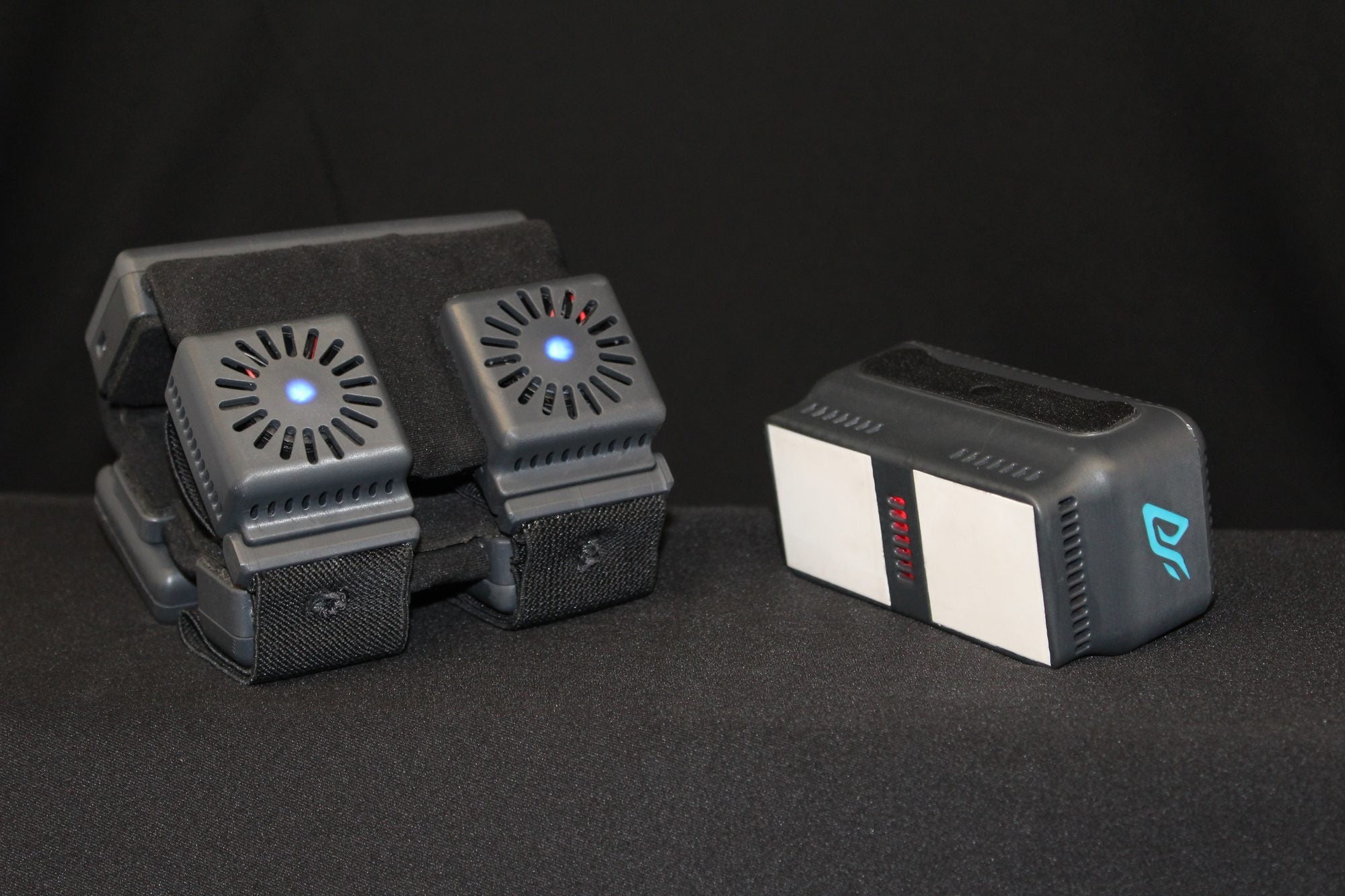
Discover how Delta Form uses temperature, pressure, and massage to create a more convenient recovery experience.
Under the skin
How heat and cold change blood flow.

At rest.
Blood vessels near the skin sit at their usual width, and blood moves at its usual pace.

Heat widens.
Warming the skin widens its blood vessels (vasodilation) and raises blood flow, which helps tight muscle and connective tissue move more freely.
Research Charkoudian 2003 · Minson 2001 · Malanga 2015

Cold narrows.
Cooling the skin narrows its blood vessels (vasoconstriction) and slows the nerves that report sensation, which is why cold dulls the feel of a sore spot.
Research Charkoudian 2003 · Gregson 2011 · Khoshnevis 2015 · Algafly 2007
Cool the Area.
Ease the Pain.
 Cold Therapy
Cold narrows the blood vessels near the skin and slows the nerves that report sensation, which is why it is a common way to cool down sore, worked muscles. In reviews, cooling after hard exercise was linked to lower reported muscle soreness over the following days.
Good for
- Muscle soreness after hard exercise
- Cooling down after a long run, lift or game
- A tired, overworked area at the end of the day
- Short, deliberate cold sessions after very hard effort
Research Gregson 2011 · Khoshnevis 2015 · Algafly 2007 · Hohenauer 2015 · Wang 2021
Relax Muscles.
Relieve Stiffness.
 Heat Therapy
Warmth widens the blood vessels in the skin and raises blood flow, which helps tight muscle and connective tissue relax and move more freely. In a review of 32 trials, heat was also linked to lower soreness after hard exercise.
Good for
- Stiff or tight muscles
- Neck and shoulders after long desk hours
- Warming up before a lift, run or stretch
- Soreness a day or two after hard exercise
Research Charkoudian 2003 · Minson 2001 · Malanga 2015 · Wang 2021 · Rousse 2025
Alternate Temperatures.
Combine the Benefits.
 Contrast Therapy
Alternating warmth and cold is a popular recovery routine, and blood flow in the limb rises and falls in turn. In a review of 18 trials, people reported less muscle soreness after contrast therapy than after passive rest, though the evidence is limited and it did not clearly beat other common methods.
Good for
- After a hard training block
- Heavy, tired legs or arms
- When you want both warmth and cold in one sitting
Research Fiscus 2005 · Bieuzen 2013 · Dupuy 2018 · Rousse 2025
Repeated Pressure.
Rhythmic Relief.
 Pulse Compression
Pulse compression squeezes and releases the band in a slow rhythm, the way a pair of hands kneads a limb. In small trials of intermittent pneumatic compression (air-filled sleeves), a session was followed by a trend toward lower perceived soreness, though it did not improve strength or jump recovery and the evidence is limited. In Delta Form, the same motor that holds the band snug runs this kneading massage.
Good for
- A kneading massage at the end of a session
- Easing the feel of soreness after hard exercise
- Tired, heavy-feeling legs and arms
- Winding down after a long day on your feet
Research Maia 2025 · Stedge 2021 · Weerapong 2005
Steady Pressure.
Consistent Support.
Static CompressionSteady, even pressure around a limb feels supportive, and in a meta-analysis compression garments were linked to lower soreness after hard exercise. In Delta Form, a small motor tightens the band and holds it there for you.
Good for
- Soreness after hard exercise
- Tired, heavy-feeling legs and arms
- Firm, even contact that keeps heat or cold where you want it
Research Hill 2014 · Dupuy 2018
Targeted Vibration.
Soothing Sensation.
Fast, repeated pulses work the surface of a muscle and can leave a tight area feeling looser. In small studies, a few minutes of percussive massage increased short-term range of motion at the joint without changing strength, and vibration raised blood flow to the skin. For a slower, kneading version on an arm or leg, see Pulse Compression.
Good for
- Loosening tight spots in the calves, quads, shoulders and back
- Getting an area ready to move
- Working an area right after cold or heat
- Easing the feel of soreness after hard exercise
Research Konrad 2020 · Nakamura 2024 · Roberts 2024 · Weerapong 2005 · Maloney-Hinds 2008
Why a device
Quick to temperature. Comfortable to the end.
An ice pack starts cold and warms from the moment it leaves the freezer. Delta Form and Delta Focus use the same heating and cooling technology, and both take 15 seconds to hot or cold.
The research
The studies behind this page.
Every title opens the study's record on PubMed, the US National Library of Medicine's index of biomedical research.
Cold4 studies
- Influence of cold water immersion on limb and cutaneous blood flow at restGregson W et al. · Am J Sports Med · 2011 · PMID 21335348
Cold water immersion reduced blood flow in the leg: conductance in the main thigh artery fell by about 30 to 40 percent in both 8 °C and 22 °C water (nine men).
- Cold-induced vasoconstriction may persist long after cooling ends: an evaluation of multiple cryotherapy unitsKhoshnevis S et al. · Knee Surg Sports Traumatol Arthrosc · 2015 · PMID 24562697
Four cryotherapy units each reduced blood perfusion in the skin under the pad. The authors describe a deep state of local vasoconstriction that can persist after cooling ends.
- The effect of cryotherapy on nerve conduction velocity, pain threshold and pain toleranceAlgafly AA et al. · Br J Sports Med · 2007 · PMID 17224445
In 23 men, icing the ankle until the skin reached 10 °C slowed nerve conduction by about a third and raised pain threshold and pain tolerance.
- The Effect of Post-Exercise Cryotherapy on Recovery Characteristics: A Systematic Review and Meta-AnalysisHohenauer E et al. · PLoS One · 2015 · PMID 26413718
A meta-analysis of 36 articles: cooling after exhausting exercise was linked to lower reported muscle soreness at 24, 48 and 96 hours than passive recovery. The trials had a high risk of bias.
Heat3 studies
- Skin blood flow in adult human thermoregulation: how it works, when it does not, and whyCharkoudian N · Mayo Clin Proc · 2003 · PMID 12744548
A review of how skin blood flow is controlled: local warming of the skin can cause maximal vasodilation in healthy people, while local cooling can reduce skin blood flow to minimal levels.
- Nitric oxide and neurally mediated regulation of skin blood flow during local heatingMinson CT et al. · J Appl Physiol (1985) · 2001 · PMID 11568143
In volunteers, local heating raised skin blood flow through two separate mechanisms: a nerve axon reflex and nitric oxide.
- Isolated and Combined Effects of Cold, Heat and Hypoxia Therapies on Muscle Recovery Following Exercise-Induced Muscle DamageRousse Y et al. · Sports Med · 2025 · PMID 40983804
A review of randomized trials: heat therapy, especially hot-water immersion, appeared the most effective for restoring muscle function after hard exercise. Local heating is less well studied, and contrast therapy looked promising but evidence is limited.
Heat and cold together2 studies
- Mechanisms and efficacy of heat and cold therapies for musculoskeletal injuryMalanga GA et al. · Postgrad Med · 2015 · PMID 25526231
A review of how cold and heat work. Cold reduces blood flow, pain and muscle spasm; heat raises blood flow and the elasticity of connective tissue. The authors note that clinical evidence for both is limited.
- Heat and cold therapy reduce pain in patients with delayed onset muscle soreness: A systematic review and meta-analysis of 32 randomized controlled trialsWang Y et al. · Phys Ther Sport · 2021 · PMID 33493991
A meta-analysis of 32 randomized trials (1,098 people): cold applied within an hour after exercise lowered soreness pain over the next 24 hours, and heat lowered soreness pain as well.
Massage, vibration and percussion5 studies
- The mechanisms of massage and effects on performance, muscle recovery and injury preventionWeerapong P et al. · Sports Med · 2005 · PMID 15730338
A review of the proposed ways massage may work: mechanical pressure, greater blood flow, effects on the nervous system and a relaxation response.
- The effect of 30 Hz vs. 50 Hz passive vibration and duration of vibration on skin blood flow in the armMaloney-Hinds C et al. · Med Sci Monit · 2008 · PMID 18301353
Vibrating the forearm at 30 or 50 Hz for 10 minutes raised skin blood flow within the first four minutes, peaking by minute five (two small studies, 18 and 7 people).
- The Acute Effects of a Percussive Massage Treatment … on Plantar Flexor Muscles' Range of Motion and PerformanceKonrad A et al. · J Sports Sci Med · 2020 · PMID 33239942
Five minutes of handheld percussive massage on the calf increased ankle range of motion by about 18 percent in 16 men, with no change in muscle strength.
- The Acute Effect of Percussive Massage Intervention with and without Heat Application on Plantar Flexor Muscles' Passive and Active PropertiesNakamura M et al. · J Sports Sci Med · 2024 · PMID 38455448
Two minutes of percussive massage, with or without added heat, increased ankle range of motion and reduced muscle stiffness in 15 men. Strength did not change.
- Effects of Percussive Massage Treatments on Symptoms Associated with Eccentric Exercise-Induced Muscle DamageRoberts TD et al. · J Sports Sci Med · 2024 · PMID 38455428
After hard arm exercise, one minute of percussive massage per visit was followed by greater range of motion over the next three days and lower soreness ratings (17 people).
Compression and contrast6 studies
- Compression garments and recovery from exercise-induced muscle damage: a meta-analysisHill J et al. · Br J Sports Med · 2014 · PMID 23757486
A meta-analysis of 12 studies: compression garments had a moderate effect on reducing soreness after damaging exercise.
- Intermittent Pneumatic Compression May Reduce Muscle Soreness but Does Not Improve Neuromuscular Function Following Exercise-Induced Muscle Damage: A Randomized Placebo-Controlled TrialMaia F et al. · Int J Sports Physiol Perform · 2025 · PMID 40555415
In 33 active men, 30 minutes of intermittent compression after hard squats did not change jump or strength recovery compared with a placebo, though perceived soreness trended lower with compression.
- The Effects of Intermittent Pneumatic Compression on the Reduction of Exercise-Induced Muscle Damage in Endurance Athletes: A Critically Appraised TopicStedge HL et al. · J Sport Rehabil · 2021 · PMID 33418535
A critical appraisal of three trials in endurance athletes: intermittent compression may give short-term relief from muscle soreness, but did not keep helping recovery from muscle damage over time.
- Contrast water therapy and exercise induced muscle damage: a systematic review and meta-analysisBieuzen F et al. · PLoS One · 2013 · PMID 23626806
A systematic review of 18 trials: contrast water therapy left people less sore than passive rest, with little difference between it and other popular recovery methods. All trials had a high risk of bias.
- Changes in lower-leg blood flow during warm-, cold-, and contrast-water therapyFiscus KA et al. · Arch Phys Med Rehabil · 2005 · PMID 16003672
In 24 healthy men, contrast water therapy made lower-leg blood flow fluctuate throughout a 20-minute treatment. Warm water (40 °C) changed blood flow significantly compared with a control, while cold water (13 °C) did not reduce it significantly.
- An Evidence-Based Approach for Choosing Post-exercise Recovery Techniques to Reduce Markers of Muscle Damage, Soreness, Fatigue, and Inflammation: A Systematic Review With Meta-AnalysisDupuy O et al. · Front Physiol · 2018 · PMID 29755363
A meta-analysis of 99 studies: massage, compression garments, immersion, contrast therapy, cryotherapy and active recovery each reduced soreness. Massage had the largest effect on soreness and fatigue.
Read this
About this page.
These studies look at cold, heat, massage, vibration, compression and contrast in general, mostly in healthy adults and often with water immersion, garments or other equipment. None of them tested Delta Form or Delta Focus. Many were small or at risk of bias, and results vary from person to person. What we have measured on the devices is on the Safety page.
This page is general information about thermotherapy, massage and compression, not medical advice. Delta Form and Delta Focus are general wellness devices and are not intended to diagnose, treat, cure or prevent any disease or condition.
Talk to a clinician about a specific injury or condition, and stop using the device if anything feels wrong.